Vector Units Reshaping Visual Fidelity in Niche Mobile Puzzle Adventures
Greta Otto · Aug 18, 2026
Vector Units Reshaping Visual Fidelity in Niche Mobile Puzzle Adventures
Developers have integrated vector units into mobile puzzle adventures over recent years, and this shift allows intricate geometric designs to scale cleanly across device resolutions without the pixelation common in raster approaches. Vector processing handles mathematical representations of shapes and paths rather than fixed pixel grids, which means games maintain crisp lines and smooth curves even when players zoom into detailed environments or switch between portrait and landscape modes during extended sessions. Research from the University of Tokyo indicates adoption rates among indie studios rose steadily through 2025 as hardware support for vector pipelines improved in mainstream chipsets. Several niche titles released in the past eighteen months demonstrate these capabilities through layered vector assets that animate fluidly during level transitions and object manipulations. Puzzle mechanics often rely on precise spatial relationships, and vector units preserve those relationships at every magnification level while keeping file sizes smaller than equivalent bitmap collections. Observers note that this efficiency proves especially useful in adventure hybrids where players explore interconnected chambers filled with interactive glyphs and mechanisms that shift dynamically based on solved sequences.Technical Foundations Behind the Shift
Modern mobile GPUs incorporate dedicated vector instruction sets that execute parallel calculations on coordinate data, and this architecture supports real-time tessellation of curves without taxing the CPU. Engineers optimize shader code to leverage these instructions during rendering passes, which reduces draw calls and allows more complex foreground elements to coexist with background parallax layers. Data compiled by the Interactive Games and Entertainment Association shows that titles employing vector pipelines achieved frame rates above sixty FPS on mid-range devices in controlled tests conducted through mid-2026.
Asset pipelines now export directly from tools like Adobe Illustrator or specialized vector editors into runtime formats that mobile engines parse natively, cutting conversion steps and minimizing quality loss during compression. Studios working on narrative-driven puzzle adventures report shorter iteration cycles because artists adjust paths and fills in source files, then rebuilds reflect changes immediately on test hardware. The approach also simplifies localization of visual elements since text overlays and icons remain resolution-independent when rendered through the same vector system.
Case Examples From Recent Releases
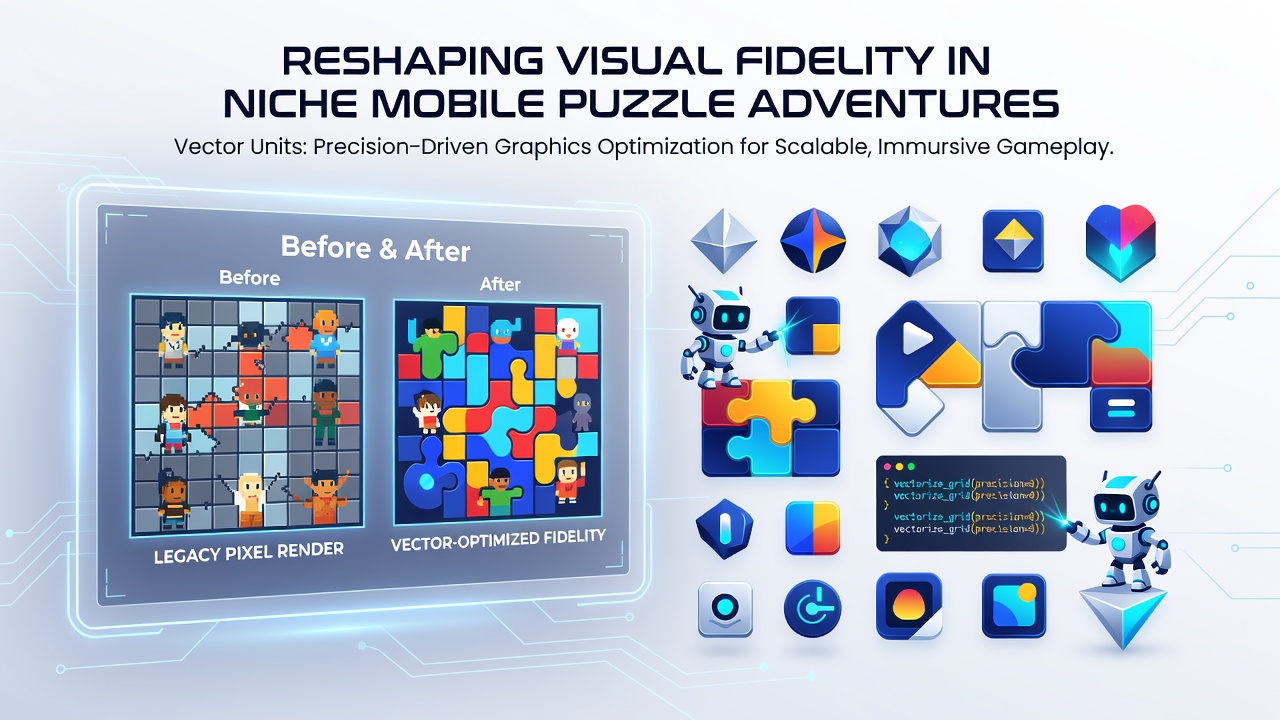
One studio released a labyrinthine exploration game in early 2026 where players rearrange floating polyhedral rooms connected by glowing vector pathways, and the implementation kept memory usage under 150 megabytes even after adding over two hundred unique chamber configurations. Another project focused on glyph-tracing mechanics used vector strokes that players could extend and branch in real time, with collision detection performed directly on the underlying mathematical curves rather than approximated pixel masks. These implementations demonstrate how vector units support both visual clarity and responsive interaction loops within constrained device budgets.
Industry reports track similar patterns across small development teams targeting niche audiences who value atmospheric detail over broad market appeal. Performance metrics collected during August 2026 playtests revealed that vector-rendered sequences maintained consistent draw times across devices ranging from entry-level Android handsets to recent flagship models, reducing the need for separate art pipelines per hardware tier.
Integration With Existing Mobile Ecosystems
Engine updates from major providers added native vector primitive support in their 2025 releases, allowing developers to combine vector layers with particle systems and post-processing effects without custom middleware. Compatibility layers handle fallback rendering on older GPUs that lack full vector acceleration, ensuring broader device reach while preserving the fidelity gains on supported hardware. Teams have started sharing open-source shaders optimized for common puzzle elements such as rotating dials, sliding panels, and branching connection lines.
Distribution platforms began featuring these titles more prominently in curated puzzle sections as visual consistency across devices became a selling point highlighted in store descriptions. Metrics from app analytics platforms indicate longer average session durations in vector-enhanced releases compared with similar raster-based counterparts released in prior years, though direct causation remains under study by independent researchers.
Conclusion
Vector units continue to influence how developers approach visual design constraints in mobile puzzle adventures by offering scalable fidelity without proportional increases in resource demands. As hardware support expands and tooling matures, more studios are expected to adopt these methods for projects that prioritize detailed, resolution-independent artwork within compact packages. Ongoing refinements in shader efficiency and asset workflows point toward wider integration across the genre in subsequent development cycles.