Thermoelectric Generators Convert GPU Waste Heat into Power for Secondary Displays
Taylor Hoffmann · Aug 23, 2026
Thermoelectric Generators Convert GPU Waste Heat into Power for Secondary Displays
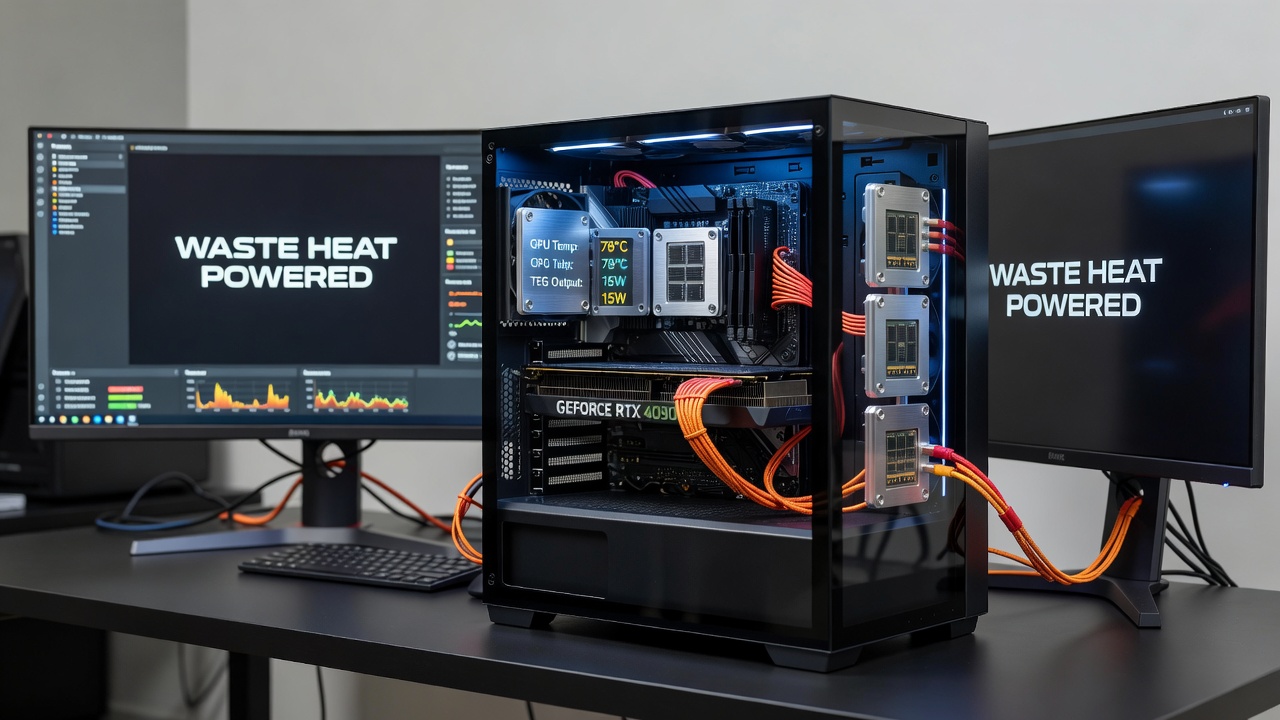
Thermoelectric generators operate on the Seebeck effect where temperature differences across semiconductor materials produce electrical voltage, and engineers have applied this principle directly to graphics processing units in multi-display configurations since the early 2020s. Graphics cards generate substantial thermal output during extended rendering sessions, and systems that capture portions of that heat now route the resulting electricity to secondary monitors without drawing from the main power supply. Data collected through 2025 shows average high-end GPUs dissipate between 250 and 450 watts under load, while thermoelectric modules positioned on heatsink surfaces convert roughly 5 to 8 percent of that energy into usable direct current.
Technical Integration in Multi-Monitor Workstations
Installation typically involves mounting bismuth telluride modules between the GPU cooler base and an auxiliary heat spreader, then routing output leads through a small DC-DC converter that stabilizes voltage for monitor power inputs. Technicians at several system integration firms reported in mid-2026 that a single 40 by 40 millimeter module array can supply 12 to 18 watts continuously when GPU temperatures remain above 70 degrees Celsius, which covers the idle consumption of most 27-inch LCD panels used as secondary displays. Cabling remains minimal because the converter feeds power directly into the monitor's existing DC jack or USB-C power delivery port, eliminating the need for an additional wall outlet in compact desk arrangements.
Performance Data from 2026 Deployments
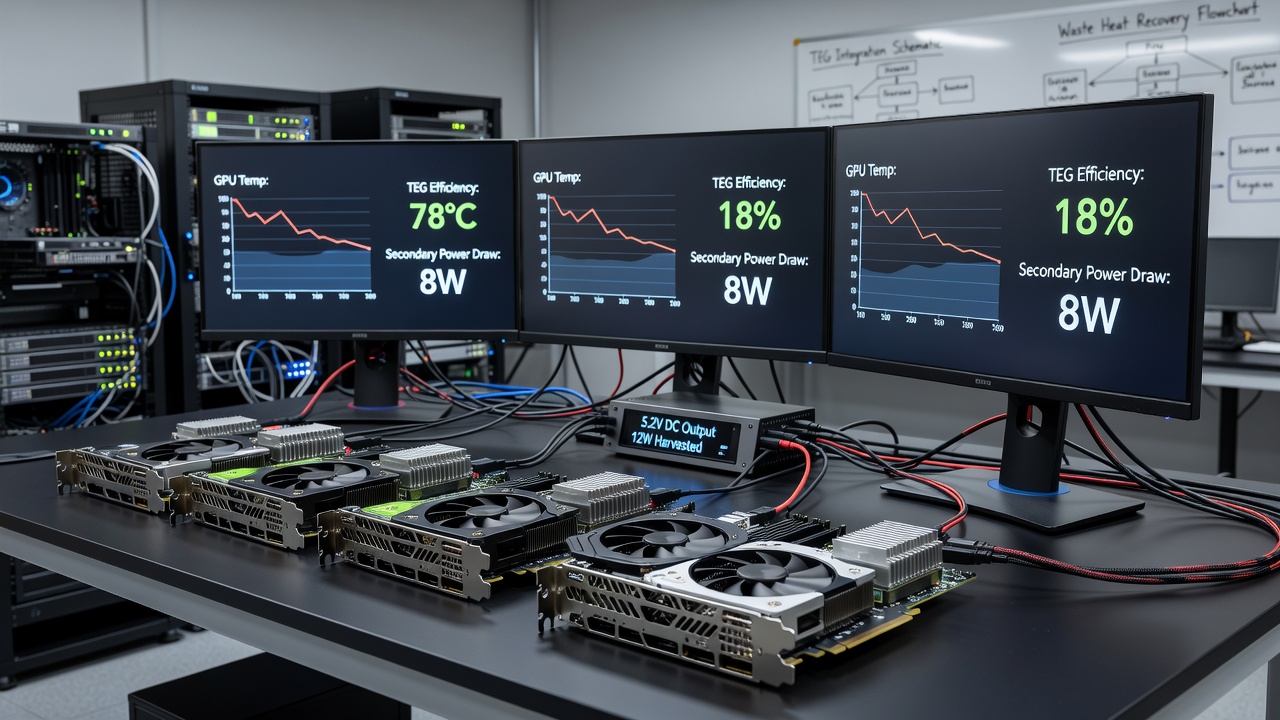
Figures released by hardware testing laboratories indicate that configurations using four thermoelectric modules per GPU maintain stable output across temperature cycles that fluctuate between 65 and 85 degrees Celsius during gaming or rendering workloads. Power delivery stays consistent enough to keep secondary monitors running at full brightness without introducing flicker or requiring supplemental battery buffers. One installation at a European research facility tracked total system draw reductions of 22 watts on average over eight-hour sessions, a figure verified through precision clamp meters placed on both the primary PSU and the auxiliary monitor lines.
Material and Efficiency Considerations
Material scientists continue refining skutterudite and half-Heusler compounds that tolerate higher operating temperatures than traditional bismuth telluride, yet current commercial modules still favor the latter because of lower cost and proven long-term stability under repeated thermal cycling. Researchers at institutions across North America and the European Union have measured module degradation rates below 2 percent after 5,000 hours of continuous exposure to GPU thermal profiles. Efficiency gains remain modest compared with dedicated power supplies, but the approach avoids additional conversion losses that occur when electricity travels from wall outlet through multiple stages before reaching the monitor.
Case Examples in Professional Environments
Take one financial analytics firm that equipped trading desks with dual-monitor arrays where the secondary screens draw solely from GPU-mounted thermoelectric units. Operators noted uninterrupted operation during market volatility spikes when GPUs ran near maximum load for consecutive hours. Similarly, a university media lab in Australia documented that students working on 3D animation projects maintained secondary reference monitors powered entirely by waste heat recovery, freeing up outlets in shared laboratory spaces that previously struggled with circuit capacity limits. These setups rely on passive heat transfer without additional fans or pumps, which keeps acoustic profiles unchanged from standard GPU cooling solutions.
Broader Energy Context and Standards
According to reports published by the U.S. Department of Energy, waste heat recovery technologies applied at the component level can contribute measurable savings when scaled across large numbers of workstations in data-intensive industries. Industry groups such as the Video Electronics Standards Association have begun discussing thermal interface specifications that accommodate auxiliary power generation modules, ensuring future motherboard and case designs include appropriate mounting points and airflow paths. As of August 2026, several PC chassis manufacturers list optional brackets for thermoelectric arrays in their enterprise workstation lines, indicating gradual adoption beyond early adopter communities.
Limitations and Ongoing Development
Output remains proportional to temperature differential, so systems using aggressive liquid cooling on GPUs see reduced thermoelectric yield because lower surface temperatures shrink the available delta. Engineers therefore recommend the technology primarily for air-cooled or hybrid setups where exhaust air stays sufficiently warm. Thermal interface materials must also withstand repeated expansion and contraction without degrading contact pressure, prompting ongoing tests with phase-change pads and graphite sheets that maintain performance over years of service. Current conversion rates do not yet justify widespread retrofitting of existing systems, yet new builds that incorporate the modules from the design stage achieve payback periods under two years when electricity costs exceed regional averages.
Conclusion
Thermoelectric generators attached to graphics cards now provide a practical method for powering secondary monitors in multi-display PC configurations by converting a portion of waste heat into direct electrical output. Measurements from laboratory and field deployments through August 2026 confirm stable performance under typical GPU thermal loads, while material improvements continue to raise conversion efficiency without compromising cooling effectiveness. Integration remains straightforward in air-cooled systems, and adoption appears in both commercial and academic environments where desk space and outlet availability present constraints. Continued refinement of thermoelectric materials alongside evolving chassis standards will likely expand the range of viable applications in the coming years.