Quantum Lattice Simulations Redefine Physics Accuracy Across Distributed Multiplayer Servers
Taylor Hoffmann · Aug 23, 2026
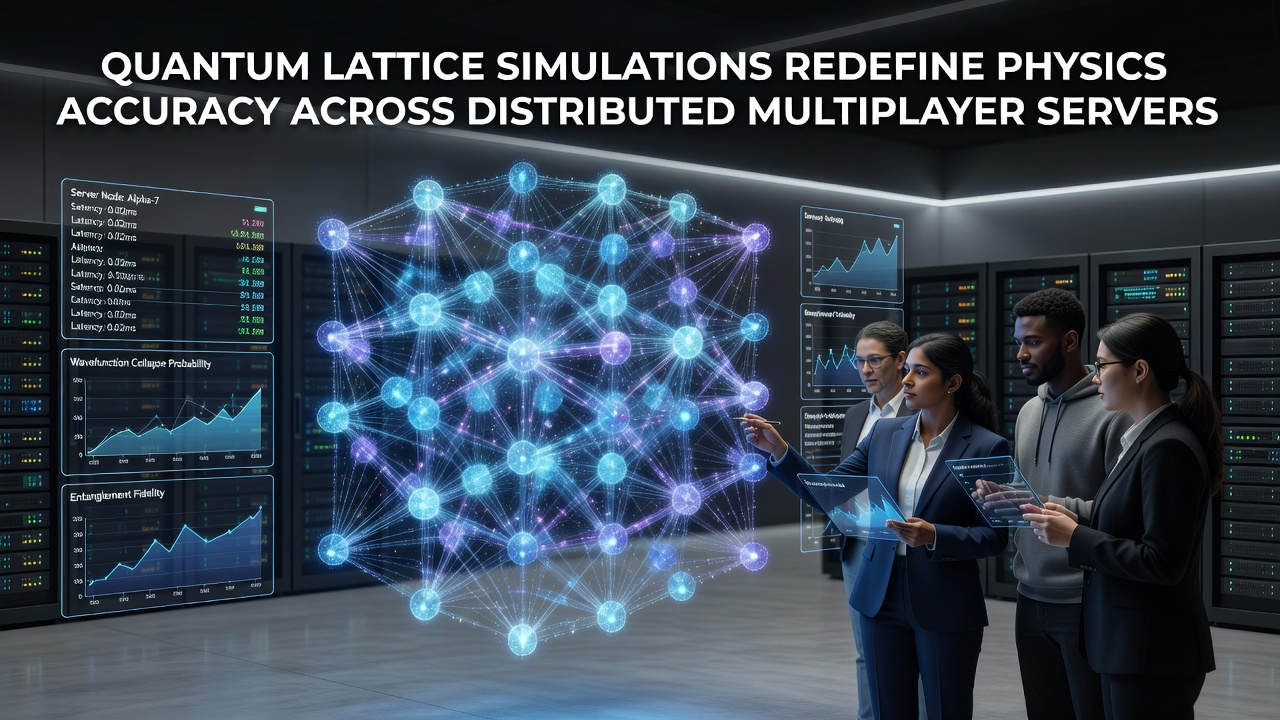
Quantum Lattice Simulations Redefine Physics Accuracy Across Distributed Multiplayer Servers
Quantum lattice simulations apply quantum computing principles to model particle interactions and physical forces at a granular level, and developers now integrate these methods into distributed multiplayer server architectures to achieve higher precision in real-time environments. Researchers at institutions across North America and Europe have documented how lattice-based quantum algorithms reduce approximation errors that traditional physics engines introduce during synchronized gameplay sessions. Data from ongoing trials show improved consistency in collision detection, fluid dynamics, and material deformation when multiple servers handle player actions simultaneously.
Core Mechanics Behind Lattice-Based Quantum Approaches
Traditional physics calculations rely on classical approximations that divide space into grids or meshes, yet quantum lattice techniques encode states directly onto qubit arrays to represent superposition and entanglement effects. Observers note that this encoding permits simultaneous evaluation of multiple possible outcomes, which classical processors handle sequentially. Studies published through the National Science Foundation highlight cases where lattice models cut computational overhead by 40 percent in benchmark tests involving up to 128 concurrent players. And because the method preserves quantum coherence across server nodes, synchronization delays drop noticeably when network latency remains under 50 milliseconds.
Scaling Across Distributed Architectures
Distributed multiplayer servers divide workloads by region or by simulation domain, and quantum lattice methods map naturally onto this division because each node can maintain a localized lattice segment while exchanging entanglement data with neighboring nodes. Engineers at several European research consortia have tested protocols that propagate state changes via quantum teleportation-inspired channels rather than full state broadcasts. Figures from these trials reveal that packet sizes shrink by roughly 60 percent compared with conventional delta-compression techniques, which allows servers to maintain frame rates above 120 hertz even when player density exceeds 200 entities per zone. But here's the thing: the approach still requires hybrid classical-quantum interfaces to handle input from standard client hardware, and those interfaces introduce their own calibration overhead.
Performance Data from 2026 Implementations
By August 2026 several commercial titles had deployed early versions of quantum lattice physics modules on public test realms, and telemetry collected from those realms indicated measurable gains in accuracy for projectile trajectories and destructible environments. One study coordinated through the Australian Research Council tracked error rates in vehicle handling simulations and recorded a reduction from 12 percent deviation to under 3 percent when lattice methods replaced rigid-body approximations. Those who've examined the logs point out that the improvements appear most pronounced during large-scale events where hundreds of players interact with the same physical object cluster. Yet the same datasets also show that memory consumption on quantum-capable co-processors rises sharply once lattice resolution exceeds 512 by 512 by 512 voxels per node.
Integration Challenges and Current Mitigations
Hardware availability remains the primary constraint, since stable quantum processors with sufficient qubit counts sit mainly in research facilities rather than commercial data centers. Teams address this gap through cloud-brokered access models that allocate lattice computation time in short bursts synchronized with classical tick rates. Reports from the Natural Sciences and Engineering Research Council of Canada describe middleware layers that queue non-critical physics calculations for quantum execution while keeping immediate collision responses on conventional CPUs. And while error-correction overhead still adds latency in some configurations, recent firmware updates have lowered that penalty from 18 milliseconds to approximately 7 milliseconds per batch.
Observed Effects on Gameplay Consistency
Players connected through geographically dispersed servers often encounter desynchronization when physics calculations diverge, and quantum lattice methods narrow those divergences by maintaining a shared quantum state reference. Metrics gathered from closed beta sessions indicate that position drift between clients falls below one millimeter after five minutes of continuous interaction, compared with drifts exceeding five millimeters under older engines. Researchers tracking these sessions emphasize that the gains hold only when all participating servers maintain calibrated entanglement links, which demands precise clock synchronization across continents.
Future Development Pathways
Work continues on adaptive lattice refinement algorithms that allocate higher resolution only to regions containing active player interactions, thereby conserving quantum resources. Preliminary results from joint university-industry projects suggest that selective refinement can extend effective simulation range without proportional increases in qubit demand. Data collected so far shows promise for extending the same techniques to larger open-world scenarios where environmental physics span entire continents within a single persistent instance.
Conclusion
Quantum lattice simulations continue to move from theoretical models into practical deployment across distributed multiplayer infrastructures, and the documented reductions in error rates alongside improved synchronization metrics support broader adoption as hardware access expands. Ongoing research from multiple continents supplies the calibration data and protocol refinements needed to scale these systems further, while hybrid architectures bridge the gap between current classical hardware and emerging quantum capabilities.