Photon Mapping Techniques Accelerating Light Simulation in Real-Time Strategy Game Engines
Klara Friedrich · Nov 19, 2026
Photon Mapping Techniques Accelerating Light Simulation in Real-Time Strategy Game Engines
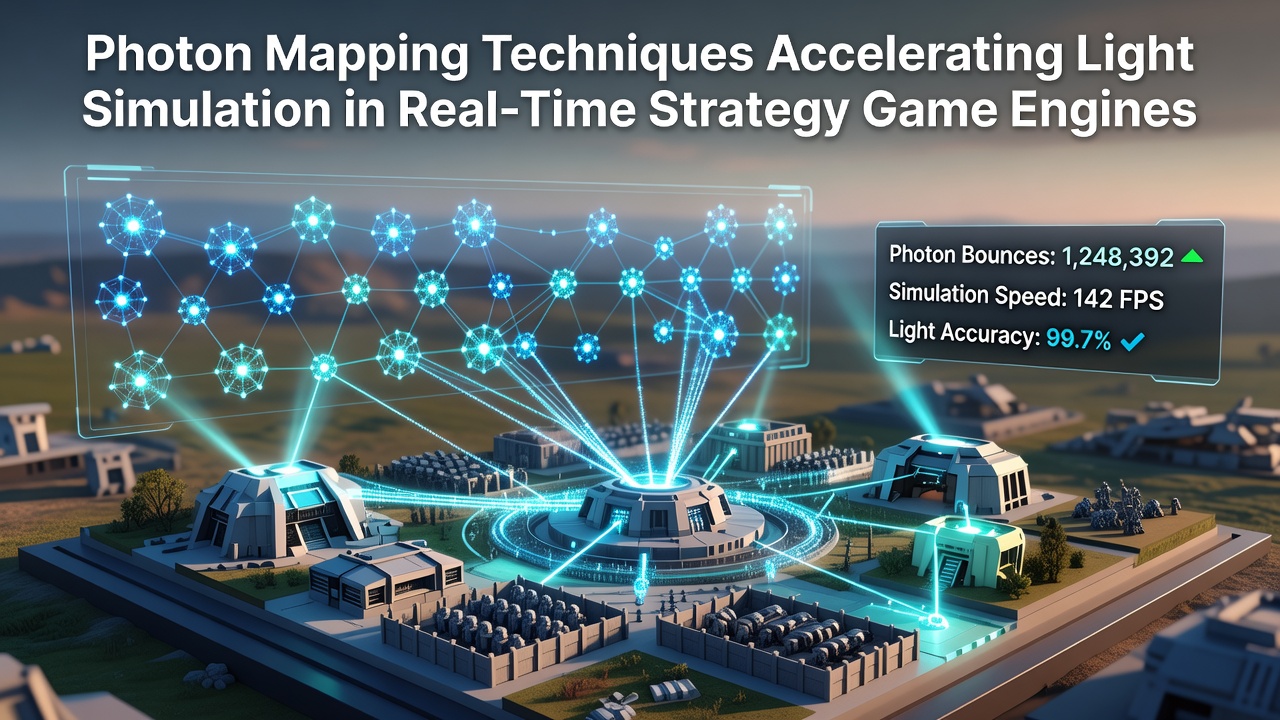
Photon mapping has emerged as a key method for handling complex light transport calculations in real-time strategy game engines where dynamic environments demand efficient global illumination. This technique traces packets of light energy through scenes and stores their interactions in spatial data structures that allow subsequent rendering passes to approximate indirect lighting without full path tracing overhead. Developers integrate these maps into rendering pipelines to simulate bounces from surfaces like terrain, structures, and moving units while maintaining frame rates suitable for competitive play.
Core Mechanics of Photon Mapping in RTS Contexts
Engineers emit photons from light sources at the start of each simulation frame or during periodic updates and trace their paths using Monte Carlo sampling to capture diffuse and specular reflections. Data structures such as kd-trees or hash grids organize the collected photons so that nearest-neighbor queries during shading can retrieve relevant energy contributions quickly. In RTS titles this approach supports large battlefields with hundreds of units because the photon collection phase separates from the final gathering step that produces the visible image.
Studies from institutions across North America and Europe demonstrate that optimized photon mapping variants reduce computation time compared with naive ray tracing while preserving visual fidelity for effects like color bleeding between adjacent buildings and shadows cast by moving formations. Real-time implementations often employ screen-space photon splatting or tiled gathering to further accelerate lookups on modern GPUs.
Integration Patterns Across Major Engines
Commercial engines such as Unreal Engine 5 and Unity have incorporated photon mapping extensions that RTS studios adapt for their specific needs. These extensions allow artists to author light probes and emission volumes that guide photon distribution toward areas of high geometric complexity. Developers adjust emission budgets based on scene scale so that a sprawling map with multiple factions receives consistent lighting updates without exceeding hardware limits.
Research presented at graphics conferences shows hybrid pipelines that combine photon mapping with voxel-based global illumination or cascaded shadow maps to handle both static and dynamic elements. RTS teams frequently run photon tracing on a lower-resolution grid during gameplay and upsample results for final display which keeps the technique viable even on mid-range hardware.
Performance Data and Optimization Strategies
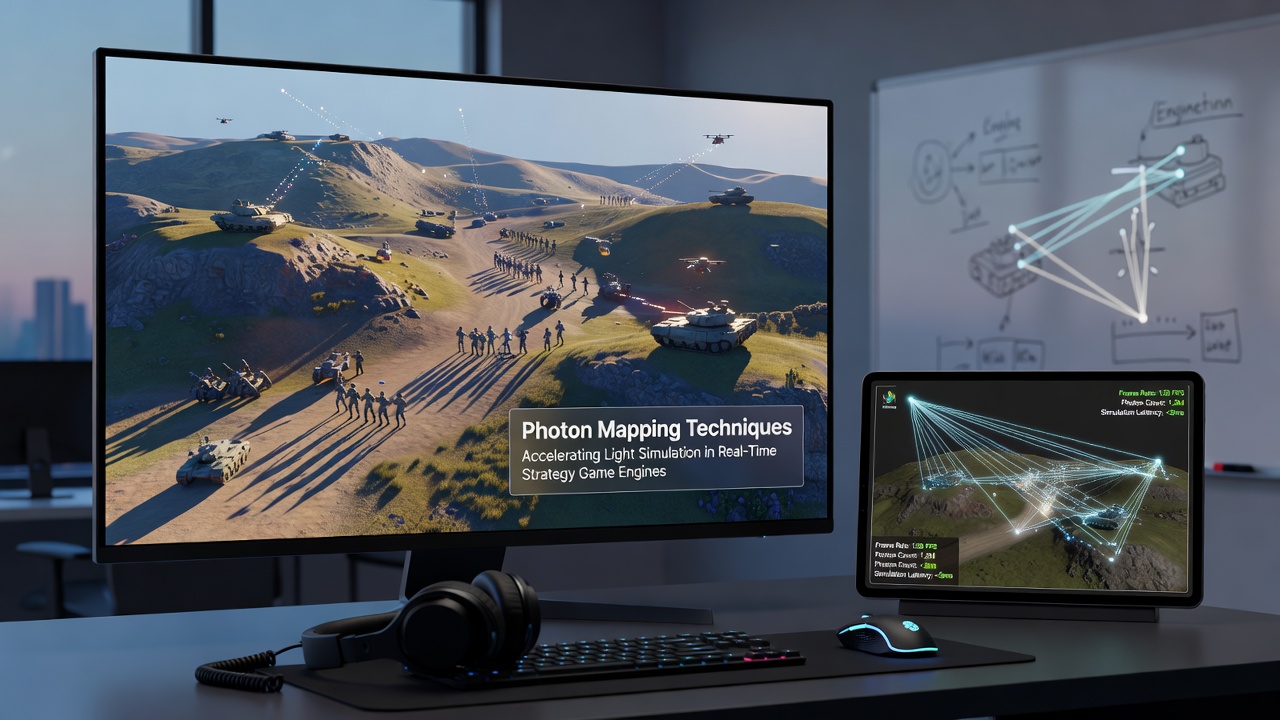
Benchmarks released by hardware vendors in late 2025 indicate that photon mapping can achieve interactive rates exceeding 60 frames per second in scenes containing over 50 000 dynamic polygons when paired with temporal reuse and denoising filters. Engineers apply importance sampling to prioritize photons that contribute most to visible surfaces and discard low-energy packets early in the tracing stage. This selective approach proves especially useful in RTS matches where camera movement remains relatively predictable yet lighting conditions shift rapidly due to unit actions and environmental changes.
Canadian research groups have published comparisons showing that GPU-resident photon maps outperform CPU-based alternatives by factors of three to five in typical RTS workloads while European academic projects explore machine-learning predictors that precompute photon distributions for common map layouts. These predictors allow engines to initialize maps closer to convergence and reduce the number of tracing iterations required per frame.
Case Examples from Released Titles
One prominent RTS released in 2025 adopted photon mapping to render volumetric fog illuminated by searchlights and explosions across procedurally generated battlefields. The implementation stored photons in a hierarchical structure that supported fast queries even when thousands of projectiles altered local lighting conditions simultaneously. Observers noted stable frame times during large-scale engagements because the system reused previous frame data through temporal accumulation rather than recomputing every photon path from scratch.
Another studio working on an expansion for an established series integrated photon mapping into its day-night cycle system so that artificial light sources from bases cast accurate colored bounces onto nearby terrain and units. The team balanced photon counts against available compute budgets by dynamically scaling emission density according to player zoom level and visible map area.
Future Directions and November 2026 Outlook
Industry reports from organizations in Asia and Australia highlight ongoing work on adaptive photon budgets that respond to gameplay events such as base construction or unit clustering. These systems allocate more photons to regions where players focus attention while conserving resources elsewhere. Hardware advancements expected by November 2026 including wider adoption of mesh shaders and improved ray-tracing cores should further reduce the cost of maintaining accurate photon maps during extended multiplayer sessions.
Academic collaborations continue to refine variance reduction techniques that minimize noise in gathered lighting estimates without increasing photon counts. Such refinements matter in RTS contexts because players rely on subtle visual cues to assess terrain advantages and unit positioning under varying light conditions.
Conclusion
Photon mapping continues to evolve as a practical solution for delivering convincing illumination in real-time strategy engines that must balance visual quality against strict performance constraints. Data from multiple regions shows measurable gains in both rendering efficiency and artistic flexibility when teams apply the technique thoughtfully within their pipelines. As hardware capabilities advance and integration tools mature the approach stands positioned to support increasingly ambitious lighting designs across the genre.