Mesh Network Protocols Power State Synchronization in Decentralized Tactical Shooter Leagues
Sam Peters · Aug 25, 2026
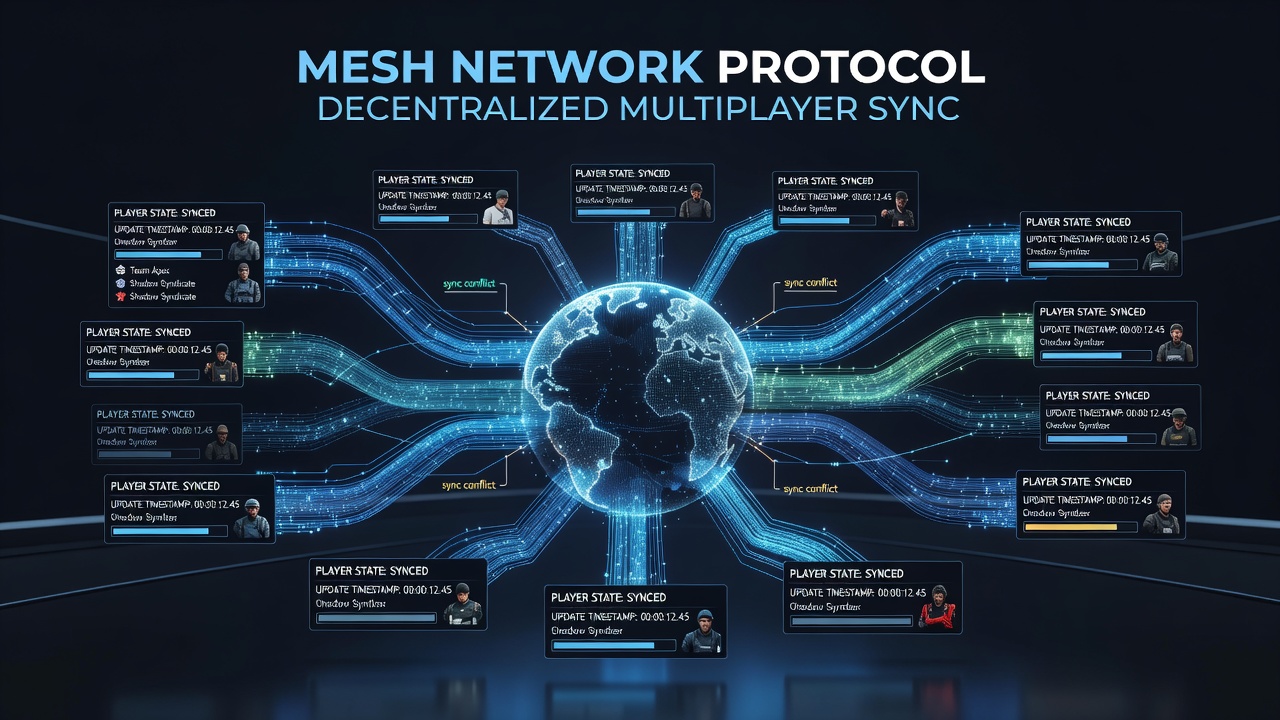
Mesh Network Protocols Power State Synchronization in Decentralized Tactical Shooter Leagues
Mesh network protocols have taken center stage in decentralized multiplayer setups for tactical shooter leagues because they distribute state updates across peer nodes rather than relying on central servers. Observers note that this approach reduces single points of failure while maintaining consistent game states such as player positions, weapon statuses, and environmental changes during intense matches. Data from industry reports indicates that leagues using these protocols achieve lower latency in peer-to-peer connections compared to traditional client-server models.
Core Mechanics of State Synchronization
State synchronization in these environments relies on delta compression techniques that transmit only changes since the last update, which cuts bandwidth demands in fast-paced tactical scenarios. Researchers at various institutions have documented how protocols like those based on gossip algorithms or epidemic dissemination spread information efficiently across the mesh, ensuring every node converges on the same game state within tight time windows. And because nodes forward packets for each other, the system stays resilient even when individual connections drop during league play.
What's interesting is the way consensus mechanisms handle conflicts, such as simultaneous shots or movement claims from different players. Studies show that vector clocks and logical timestamps help order events without a central authority, while cryptographic signatures verify the authenticity of each update. Figures from network analyses reveal that this setup supports up to several dozen players per match with sub-50-millisecond consistency windows in controlled tests.
Applications in Tactical Shooter Leagues
Tactical shooter leagues have adopted mesh protocols to enable matches in regions with unreliable infrastructure, since the decentralized design routes around congestion by leveraging multiple paths between nodes. One case study from European esports organizers highlighted successful deployments where teams competed across borders without dedicated servers, relying instead on player-hosted meshes that self-healed after disruptions. Data indicates synchronization remains stable even as players join or leave mid-match, which suits the fluid roster changes common in league seasons.

League operators schedule major tournaments for August 2026 that will test scaled mesh implementations under tournament conditions, with protocols tuned for higher player counts and more complex environmental interactions. Those implementations incorporate adaptive routing that prioritizes critical state elements like hit registration over less urgent updates such as cosmetic animations. According to findings shared by the European Telecommunications Standards Institute, these optimizations maintain fairness across diverse connection qualities that competitors bring to events.
Technical Challenges and Protocol Responses
Bandwidth variability and packet loss present ongoing hurdles, yet mesh protocols counter them through redundant transmissions and forward error correction that reconstruct missing state fragments at receiving nodes. Observers have noted that protocols incorporating machine learning for traffic prediction adjust update frequencies dynamically, sending more frequent position deltas when movement accelerates during firefights. Research from Canadian academic groups shows these predictive adjustments reduce perceived lag by measurable margins in simulated league environments.
Security considerations also drive protocol design, since decentralized networks expose more surfaces for tampering attempts. Teams integrate zero-knowledge proofs and secure multi-party computation to validate updates without revealing underlying player strategies, a technique documented in reports from the National Institute of Standards and Technology. Leagues enforce these measures through standardized client software that all participants must run, ensuring uniform protocol compliance across matches.
Future Directions for League Infrastructure
Developments continue as protocol stacks evolve to support hybrid meshes that blend local player networks with occasional cloud-assisted reconciliation for very large events. Those who've studied current deployments point to improved hardware in consumer routers that now handles the computational load of state verification natively. As August 2026 events approach, organizers prepare to release performance metrics that will benchmark mesh-based synchronization against legacy systems under identical tournament loads.
Conclusion
Mesh network protocols continue to shape how tactical shooter leagues manage decentralized state synchronization by distributing updates efficiently while preserving competitive integrity. Evidence from ongoing implementations demonstrates reliable performance across varied network conditions, and upcoming 2026 tournaments will provide further data on their scalability. Industry groups and research bodies track these advances closely as the technology matures.